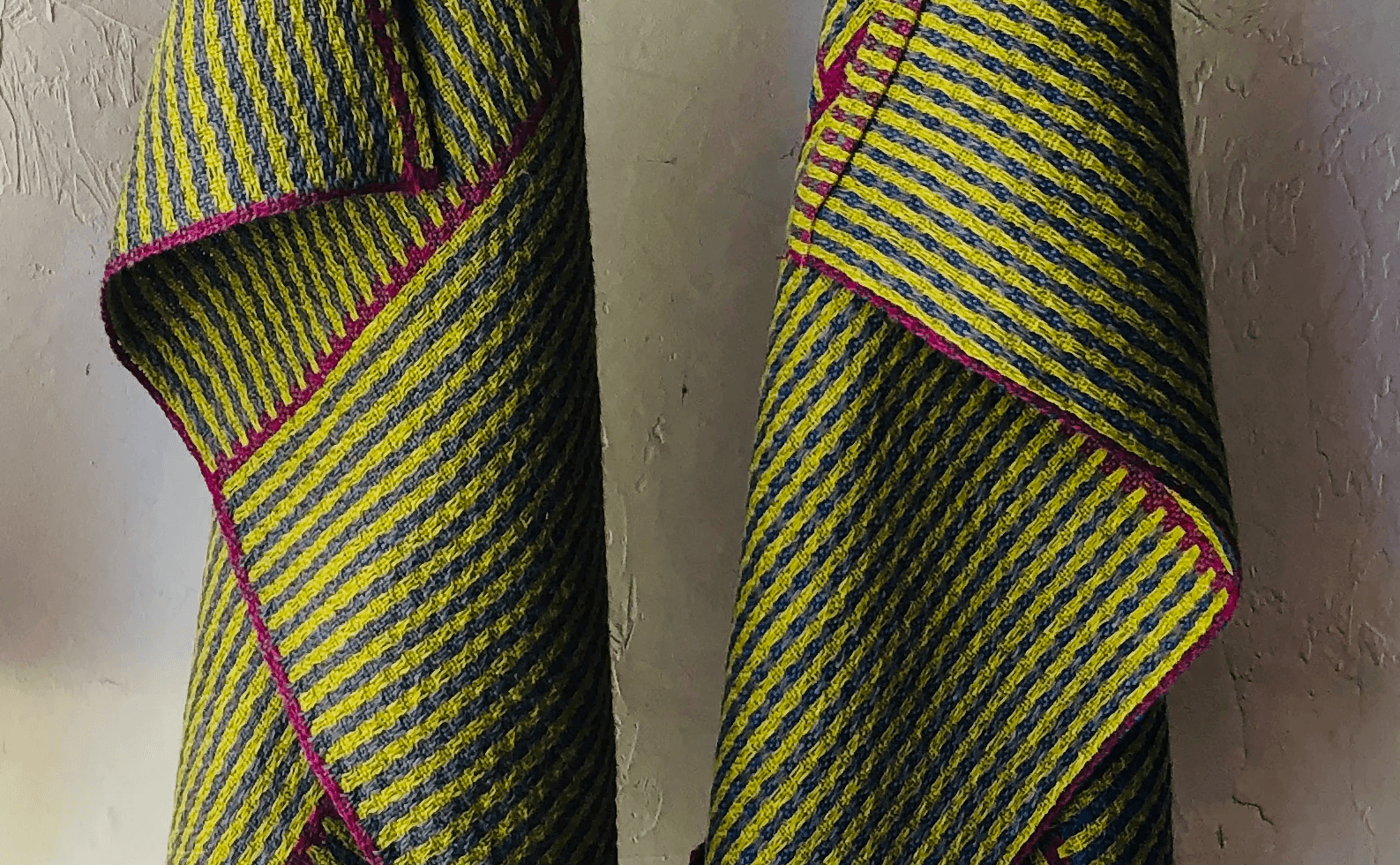
The Weight of a Towel
A towel is never just a towel. After 30 years at the loom, every thread carries the weight of judgment, technique, and a little bit of "loom therapy." This is why handwoven cloth feels different—it’s weighted by a lifetime of experience.
When is a towel not just a towel? Every project I put on the loom carries a lot of weight (even if it doesn’t know it). I am not only talking about the different “missions”—for example, needing window shades, a wedding gift, or new towels; or perhaps I am writing a project article, prepping samples for a class, or flirting with a new structure. I mean that once a project finds itself on one of my looms, I am faced with a barrage of thoughts, ideas, and revelations about weaving and about myself. Therapy, anyone?
Some of these thought categories might be:
Judgment: When I have committed to a project by designing it, winding the warp, and dressing the loom, I am faced with all the questions of judgment. Do the colors work well? Did I choose the correct sett? Is the structure working the way I had envisioned? Did I think hard enough about fiber choice, proportion, borders, beat, etc.?
These are all important questions and can be seen as an obvious way to review the project in process in order to tweak it for a better outcome. And there are some ways to improve a project once it is in process. Yes, you can resley for an improved sett, and weft color choices and treadling variations can have a big impact; however, the choices made in the warp are set and can only be changed to a certain degree.
Many of you will think, “Shouldn’t all these questions be asked and answered in the SAMPLE?” Yesss, but, that’s not how I roll. If I feel that I have made an error in my set-up (I am speaking about design rather than technical issues here), I have a lot of time at the loom to re-hash what those errors are and why I made them. This is the therapy part.
Some errors in judgment have to do with time and yarn constraints that I only have so much control over, but others make me ask myself hard questions about my process. I have been weaving for over 30 years, and my questions have changed a lot in the course of my weaving life. I was less annoyed in the past with a so-so outcome. I took to heart Laurie Autio's comment that “you’re not just making a project, you’re making a weaver,” so less-than-satisfactory outcomes were to be expected and part of the learning process. This was great—it made me creatively freer and very willing to learn and experiment. But I was also a much faster and more prolific weaver at 35 than I am at (almost) 65.
Now, I find that I am more frustrated with poor design choices and less forgiving with myself for making them. If a project looks like it might not be up to snuff within the first few inches, I start to list my character flaws—impatience, wastefulness, lack of creativity, etc. I also find the weaving process less compelling than I used to. I remember reading something Madelyn van der Hoogt wrote saying that once she had woven the first few inches of a project (and it had revealed itself), she would lose interest. I remember being shocked reading it at the time because every minute spent at the loom was a joy to me then—every inch was a challenge and a revelation—and finishing any project was pure excitement. I have now joined Madelyn in being excited for the first few inches and then being “disciplined” for the rest of the 4, 6, 8, or 10-yard warp. I think that my new impatience with poor design decisions is directly related to this. Weaving off a disappointing project is pretty tolerable when the whole process is thrilling to you, but after so many years of sitting at the loom, you have to be pretty sure of the beauty, innovation, or excellence of your project to be thrilled to spend another 24–48 hours (at least) with it.
Value: This is a tricky one. Because I am not a production weaver, I don’t have an economic framework in mind for what I do (and spend untold hours on). I value the process and product probably more than it is “worth” in the market. And I tend to weave what I want to explore and learn, then use, sell or give away the resultant product if I think it is worthy. The cost of handwoven items (materials, expertise, time, equipment, space) is hard to justify in a market that is driven by efficiency and volume and in which mechanization is pretty amazing. It is also hard to convey to “civilians” the intangible qualities of handwoven cloth that make it so special to those of us who think about it all the time. I believe, now more than ever, that quality materials are essential. One of the things that seems to be lacking in the overly abundant world of commercial cloth is truly quality fiber. I tend to stick with natural fibers, and I can say that handling lovely linen, soft cotton and plumpy wool is one of the true perks of the job (if only there were more colors!)
When I am in my studio, I work to be as efficient as I can—not to bring my hourly wage up (from $1 to $1.25?), but because it is a pleasure to work efficiently and smoothly. That smoothness in the process often transfers to the product. But along with efficiency and technical mastery, there is a thought I have while at the loom, particularly when making something for daily use: 'I will have touched every thread of this item, literally and in the design and conception, and that touch will somehow be conveyed to the user as care as they dry their dishes or cozy up on the couch.' That is something to be valued, I think.
Technical Strengths and Weaknesses: Another line of thought that goes with me to the loom is, of course, technique. I am lucky to have a great studio and great equipment (see: privilege), as well as 30 years of winding warps and dressing looms, so I very rarely have warp issues beyond a broken thread here or there. The technical issues that I am still trying to master are beat, sett, and selvedges.
Every warp is different, with different fibers, structures, and setts. Unless you are a production weaver weaving the same thing in the same fibers over and over, you will encounter new behaviors in the interaction between sett, beat, and structure with every warp. The width of the project, the loom, the tension, whether you are using a temple, and how often you advance will all impact your beat. It is not surprising that beat is a moving target that has to be learned and re-learned with every project.
But another piece of this is more personal: attention. How much attention can you muster as a weaver? Can you really measure every inch of weaving, or can you find a sett for the project/fiber/structure that sets (no pun intended) you free? I know myself, and as you might have gathered, my mind roams once I am into a project; I really want to find the sett that will free me from the necessity of constant attention. I still struggle with where to focus my attention. Once I have the treadling sequence, even if it is complex, my feet will mostly do that work, but I still need to look at the treadling draft from time to time, check the emerging cloth for errors, manage my shuttles, and advance regularly. It is a dance, and sometimes I am light on my feet, and sometimes not.
I also think about aging while I am at the loom these days. It is interesting to observe the meeting of experience and the inevitable consequences of aging. I have been “practicing” for a long time and the shuttle is almost like a bodily appendage to me at this point, but my hands are stiffer than they used to be, I am slower (less frenzied is how I like to think about it), and I am not as willing to sit at the loom for eight hours straight. I would be curious to see a line graph curving upward to show skill increasing through practice meeting the downward curved line of skill diminishing through physical deterioration. Where do the lines meet? Anyway, not there yet, hopefully.
Planning: Véronique and I talk a lot about our different approaches to planning. I like to do a complete draft on the computer with full threading, treadling, and colors before I wind my warp. Véronique will often do the full threading with color changes, but a single repeat in the treadling, because she likes to riff at the loom. My designs are less about color play, so seeing how a motif will repeat for the whole piece is important to me. This is a blessing and a curse. I find great joy in refining designs at the laptop—the version histories of some of my designs are kind of scary—but it does leave me less interested at the loom. While Véronique is fully engaged making decisions at the loom, I am (if my plan was a good one) merely executing. In order to stay interested, I am often thinking about the next variation or about judgment, technique, and so on.
Memory: This is another thing I like to mull while at the loom. I have woven miles of cloth at this point, and I am not and sadly never was a good note taker. I believe that early on I was sure that I would remember everything (ha!). There are, to be sure, memorable mistakes that seared themselves into my memory and that I have never made again, but there are a lot of “lessons learned” that I have “learned” over and over again, and believe I will continue to “learn” until I have thrown in the (handwoven) towel. When the whole weaving process is new, you are paying such close attention to every step because you have to. Once it becomes second nature, you can let your mind wander during the more rote parts of the process. It is one of the great joys of weaving practice I think – the varied states of mind required to complete the whole process. Thinking creatively, thinking technically, not thinking and achieving flow are all parts that enable us to sustain.
I have a good gestalt memory of many weave structures. I understand when they will be a good match for a project and though I might need a reference to double check, I can probably come up with a draft from memory. What I am curious about is how limiting that is for me. Do I return to the same structures again and again because I really like them, or because I know them? Is there a magical structure out there that I would love, but haven’t stumbled upon yet? Similarly, I have a pretty epic stash, but I have stopped “collecting” yarns the way I did as a newer weaver. Is this a practical approach to use what I have and like, or am I limiting my creativity by sticking with old faves? This topic naturally drifts into the next one which is Habits.
Habits: We all have habits, both good and bad. And we all know some of the habits we have that we like and ones that we wish we could change, but what are the habits we have that we might not be aware of? Once you have established your weaving practice and gotten used to your looms, wouldn’t it be interesting to have the equivalent of a physical therapist observe you? I don’t mean just for bad posture or un-ergonomic shuttle throwing, but for extra steps in your warping sequence, or bad warp advancing regularity, etc. I think we evolve as weavers from the “rules” that we were taught to a state where we feel adept enough as weavers to question those rules and re-establish practices that might better suit our studios, looms, bodies and projects. But there have to be blind spots.
I have worked with several master weaving teachers and I feel like those experiences were pivotal. Seeing other weavers who work very differently, but at a high level is quite eye opening, and makes you look at your methods with a critical eye, not because what you do doesn’t work, but because maybe there is an easier, more efficient way. Or maybe not. Seeing a variety of approaches can be helpful in both changing or confirming your choices.
Privilege: I also think about my weaving practice and how (though I seem to complain a lot) it is core to my happiness in life. I love to travel, visit family and friends, and go to museums, etc., but if I am away from my looms for too long, I feel restless and itchy fingered. I realize that I am extremely privileged to have been able to spend the 10,000 (plus!) hours it took/takes to become competent, the funds to acquire stellar equipment that makes every step of the process more successful and easier (12-peg winding station and warping reel, y’all) and access to a weaving community that is knowledgeable and inviting. On top of all this, in the middle of my weaving life I was able to build a studio in our barn just as I was finishing my master weaver certification program. Having a dedicated work space made what had been an interest of mine that took place in the spare time and spare space of a busy household into my job. Soon after getting my certification and studio, I became a technical editor, pattern writer and weaving teacher. I realize what a privilege this has been and I am grateful every day.
These are a few of the thoughts I have while communing with cloth at the loom. I hope you weavers find something that resonates or amuses and to all the wonderful customers who are willing to shell out for this stuff – if you think the handwoven towel you just bought is a little heavier than your commercial ones, this is why.
Lisa
Banner picture: Handwoven towel detail Gist Italian Cotton Linen
Comments