Is this a difficult project? Well...
or How design influences difficulty
I’ve long been interested in figuring out what makes a weaving project easy or difficult. Lisa and I tried to give a difficulty rating to our patterns [click here for a gallery of our patterns]. We listed various elements we think influence the ease of weaving, trying to calculate a number that encapsulate these elements. In the end, we gave each pattern a difficulty rating as a gut feeling rather than a calculation. We also made available how each pattern scored on their constituent elements [check out the details here], and that information may be more useful to weavers to gauge if a given pattern is within easy reach or will be a stretch.
In the spreadsheet, we listed various technical elements of the projects, such as how easy it is to wind the warp or how many shuttles are used at the same time. We did not address design elements that can make a project easy or challenging. It so happens that a while back I wove a pair of projects that have many similarities (same structure, yarn, end use), yet one is much easier than the other. One is fully written out (it’s actually the first weaving pattern I wrote), the other is languishing at the back of my mind in the “I need to write this thing out” pile. They offer a perfect example of how design elements greatly influence the difficulty of a weaving project.
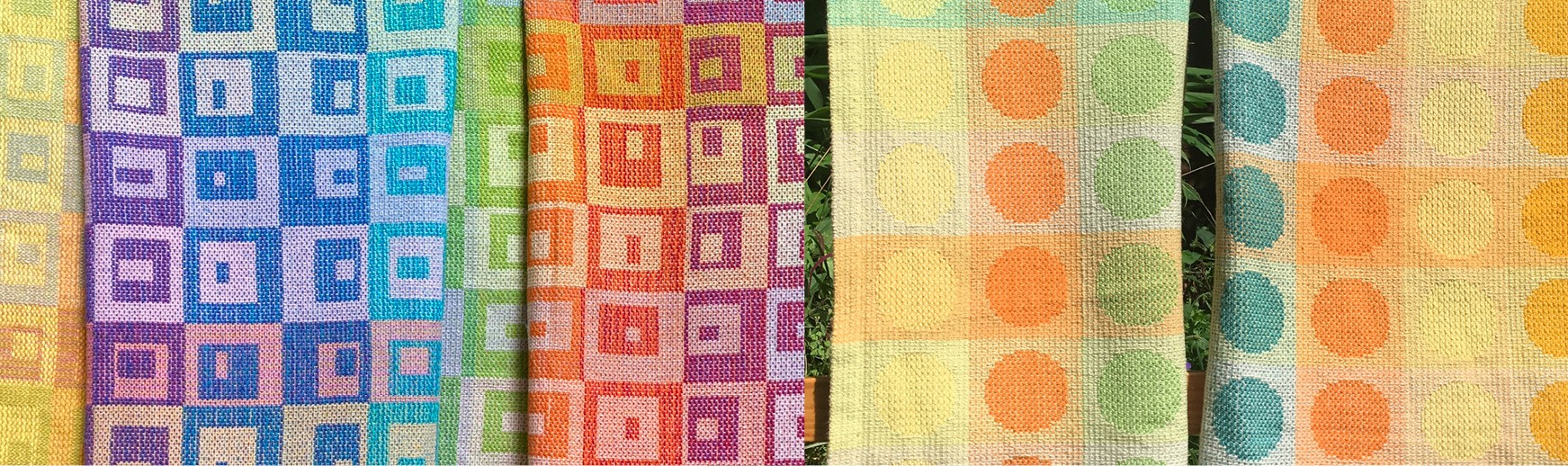
The contestants, portrayed in the banner picture
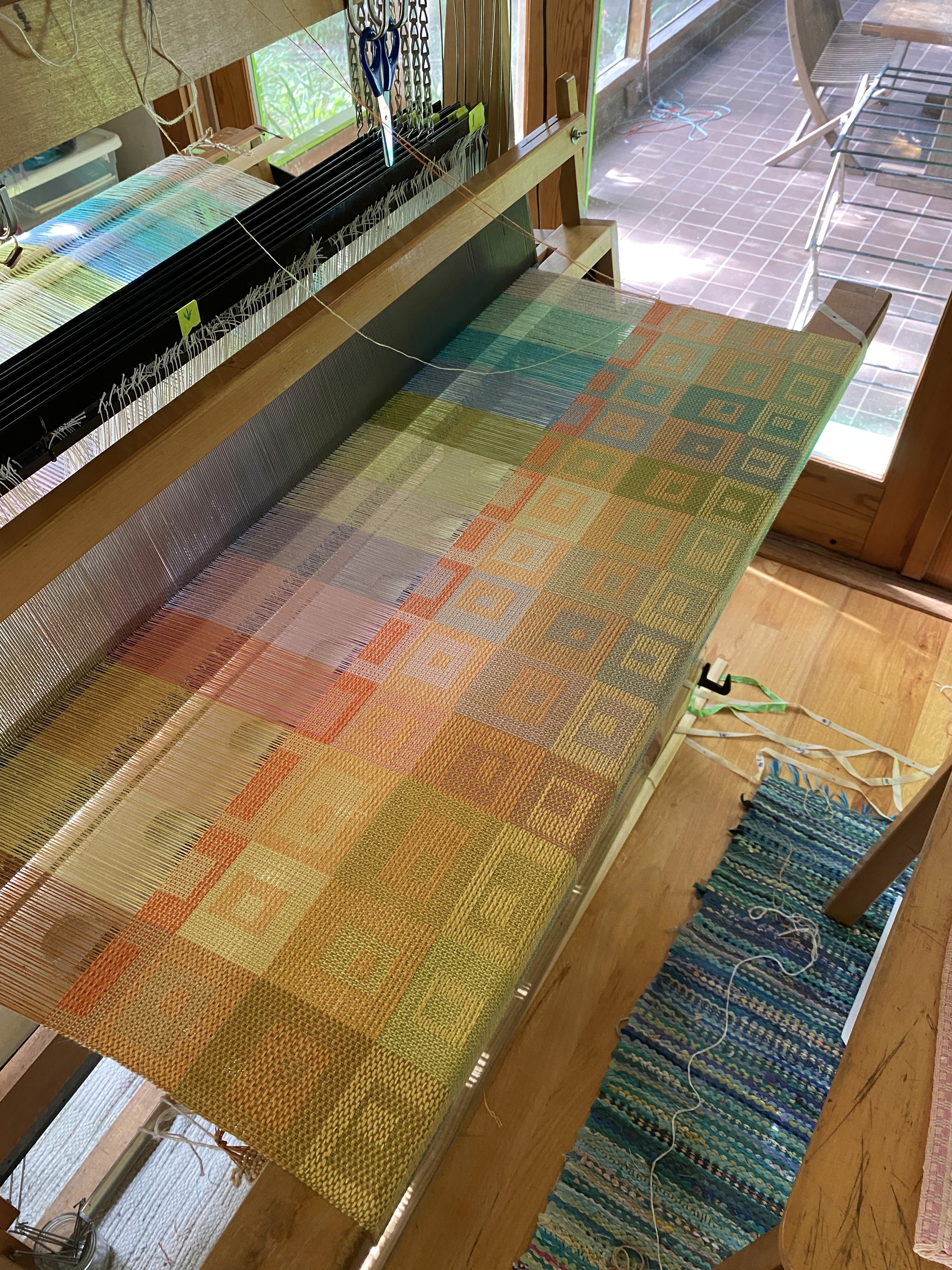
On my left, we have baby blankets woven in Summer and Winter in cotton and cottolin (8/2 for warp and tabby weft, 8/2 doubled for pattern weft), in a pattern of irregular squares-within-squares known by some as Drunken Squares (see note at the end of this post for more about Drunken Squares). I gave this pattern the color treatment by using a striped warp, with one color for each repeat, and changing the color of the wefts now and again.
On my right, we have baby blankets woven in Summer and Winter in cotton and cottolin (8/2 for warp and tabby weft, 3/2 for pattern weft), in a pattern of regular circles woven in different colors of pattern weft.
Drunken squares on the loom
Drunken Squares
This incarnation of Drunken Squares is woven on a warp made of stripes with various colors and widths; the width of the stripe matches the width of the repeat. If the warp is wound 2 ends in hand, one full circuit of the warping board yields 4 ends, which is the number of ends in a Summer & Winter unit. This means that if the weaver miscounts the number of warping board circuits, the stripe will still accommodate an exact number of Summer & Winter units, even if not exactly the number in the pattern. However, since the (official) width of each stripe varies, nobody will be any the wiser.
When weaving the piece, the exact sett achieved by the weaver is not crucial, as none of the "squares" have to be square, and the number of treadling units in each block varies at the whim of the weaver. It is more important that the beat be regular so the cloth has a consistent hand across the length of the piece.
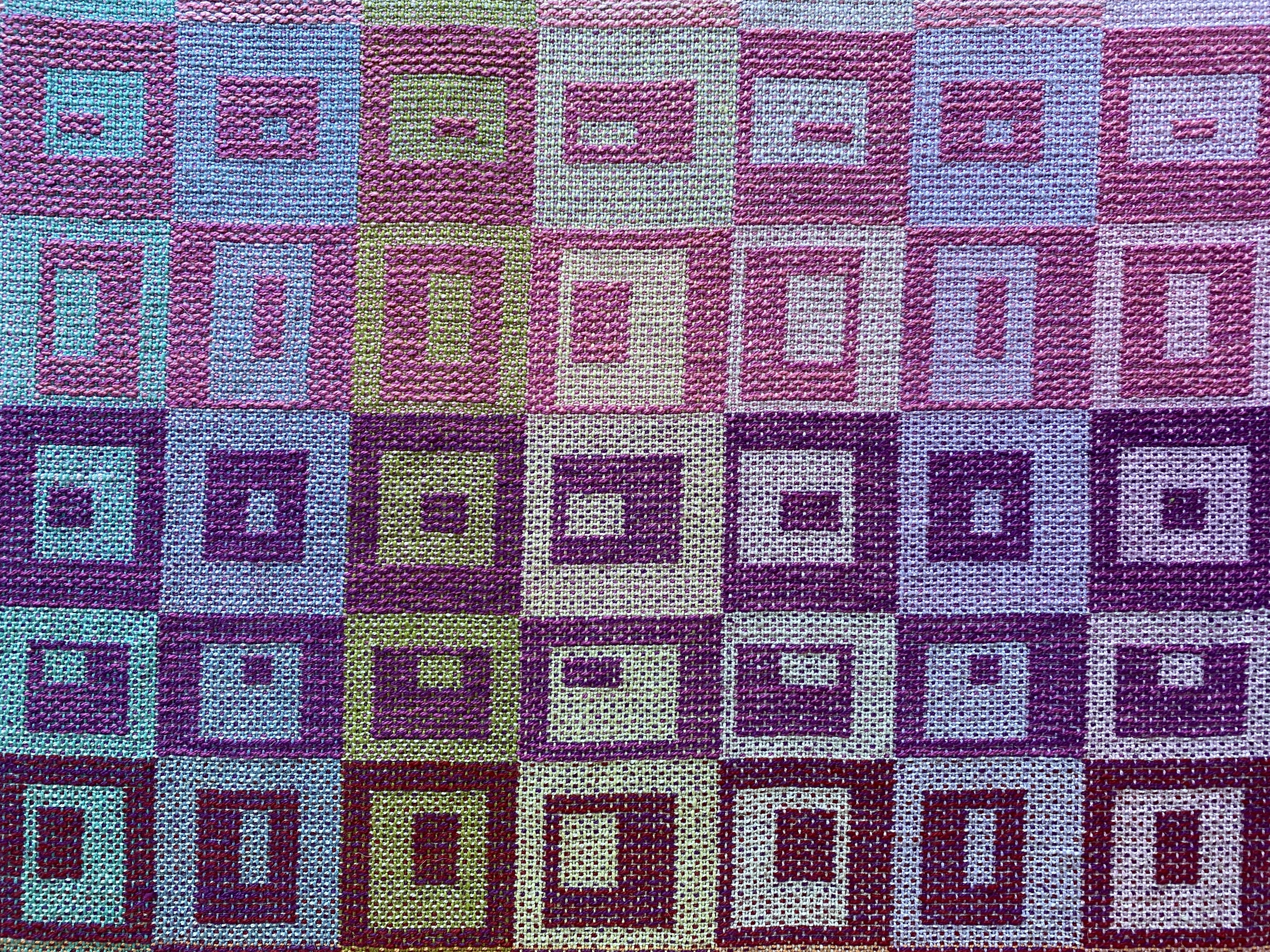
Detail of Drunken Squares, showing 7 warp repeats each in a different color, and 5 weft repeats with 3 pattern weft colors.
Lastly, the pattern is very legible: while threading, and especially while treadling, it is easy to tell the 6 pattern blocks from each other. It is easy to find where one is in the pattern by looking at the cloth, and thus to know what to do next.
Sunspots on the loom
Sunspots
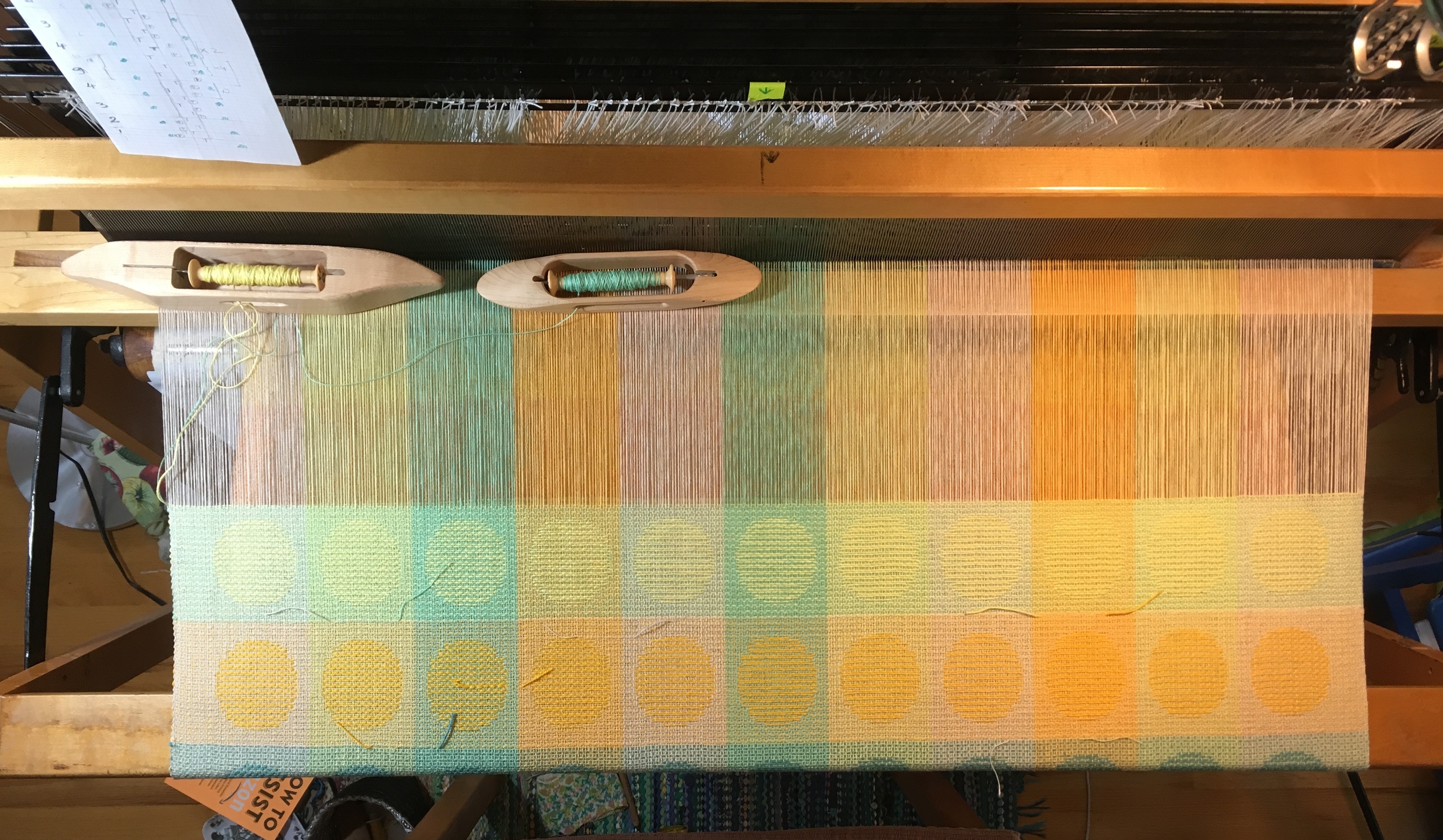
Sunspots is also woven on a striped warp, with one repeat of the pattern per stripe (for more about the Sunspots pattern, click here). The stripes are regular; they appear only in the background, and small irregularities would not be very noticeable. On the other hand, the threading has to be precise for the edges of the circles to be as smooth as possible. Mistakes (i.e, threading the pattern warp ends on the wrong shaft) are hard to spot in the curved parts of the circle. This lack of legibility also holds while weaving, and treadling mistakes (i.e., treadling the wrong pattern shafts) are quasi invisible on the loom, but quite noticeable on the finished piece (at least by weavers; the baby using the blanket doesn't seem to mind). This means that the weaver has to pay close attention to where they are on the treadling sequence, at least until they are familiar with the motif.
Lisa pointed out that there is a color element in the difficulty of this pattern: the colors I chose for this project don't help make the pattern more legible. More value contrast between warp and pattern weft would make it easier to read the pattern.
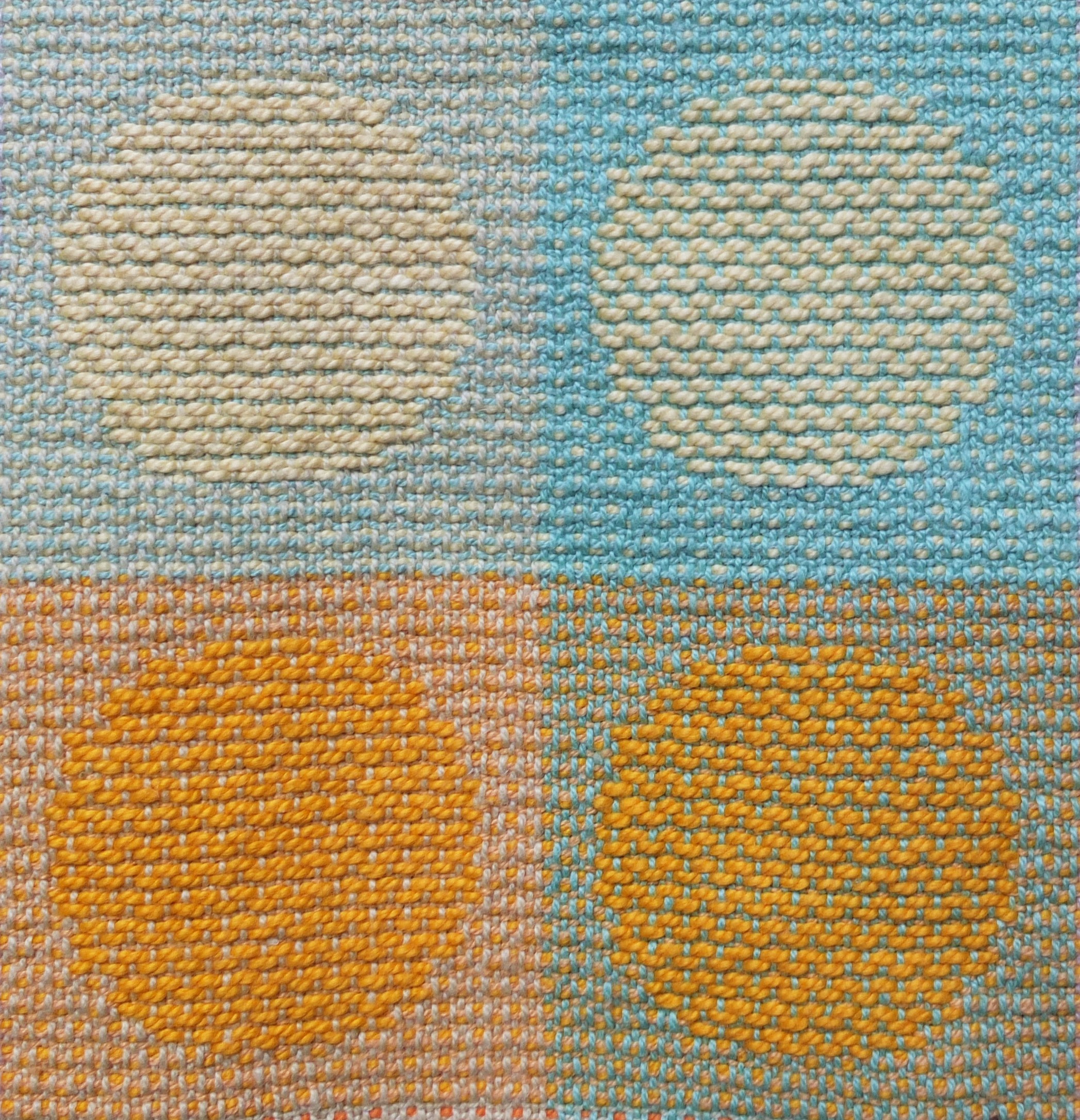
Two repeats in warp and weft of the Sunspots circles after finishing
The trickiest part of this project is getting round circles on the finished piece. I first wove a couple of pattern repeats to adjust the treadling sequence, aiming for round circles on the loom. Fortunately, I cut off the sample and washed it. Somewhat to my surprise, there was more shrinkage in warp than in weft, and the round circles on the loom ended up noticeably less round in the finished cloth. (Relaxing tension to assess the circles on the loom does not do the trick: water has to be involved for the fibers to really shrink.) It took a couple of iterations to get round circles in my hands, that is, with a comfortable beat at the width of the project and with the firm tension I like on my loom. In the pattern instructions, I recommend that weavers weave a sample and finish it so they can adjust the treadling sequence to get round circles after finishing. Matching my beat may or may not do the trick, as I suspect that the tension on the warp affects the warp shrinkage, which affects the shape of the circles.
And the winner is…
Can you tell which baby blanket is easier to weave? Even though both blankets are woven in the same structure with the same yarns (or close enough), the design of Sunspots requires precision and some sampling to be successful, which, here, means round circles. Not that this is the only way to weave this project, of course. Once the warp is threaded, the weaver could decide to ditch the circles and weave a bunch of ovals! For example, the weaver could start with the very shortest “circles” (= horizontal ovals) and stretch the motif at each repeat to go all the way to vertical ovals.
By comparison, Drunken Squares thrives on irregularity. It is a happy-go-lucky project that works well with some whimsy. It is a perfect first Summer & Winter project, one that can be woven anew each time.
Which project is best for you? If you need a baby blanket in a hurry, or you are new to Summer & Winter, Drunken Squares is for you — as soon as I write the pattern, that is. If you want a challenging project, or you relish precision weaving, you'll enjoy Sunspots. Either way, the babies in your life and their parents will be grateful for a blanket woven with love, even if there are a few mistakes here and there.
Note on Drunken Squares
This squares-within-squares pattern is floating around. I don’t remember where I saw it first, but it appeared in Daryl Lancaster’s blog in 2021 (https://weaversew.com/wordblog/tag/drunken-squares/) and in on page 182 of Betty Briand’s book L’art du tissage (2021 in the original French; translated in English as The Art of Weaving, 2023). I reverse-engineered it (before coming across Daryl’s analysis) as a 6 block pattern. With only 8 shafts at my disposal, Summer & Winter is the easiest way to weave it.
March 2026 update: at the request of some readers, I wrote the pattern for this baby blanket. It is available at the Etsy store under the name Dancing Squares Baby Balnket.
Véronique
Banner picture: Drunken Squares and Sunspots baby blankets, side by side in a composite picture. A couple of each kind of blanket are shown folded over a rod; warp is horizontal.
Comments