Let’s talk about sett, baby!
One of the first things Lisa and I wanted to talk about on Groundweave was SETT! And we have a lot to say about it…
Some of it is already available on GroundWeave. If you are interested in the relationship between thread spacing in the warp (ends per inch, or epi) and in the weft (picks per inch, or ppi), check out this diagram. If you are interested in what elements of a weaving project influence the sett, check out this diagram.
This is all and well, but these complicated diagrams don’t directly answer the first question many weavers ask when it comes to sett: how do I choose the sett for the weaving project I am designing? [Note that this question is related to another question, one that comes up regularly from weavers who purchased one of our patterns: can I use this yarn instead of the one you specify in the pattern?—we’ll get to yarn substitution later.]
Many weavers figure out the sett from previous experience (theirs or someone else’s). Of course, it’s easier to do more of the same: I will sett a warp of towels in 8/2 cotton woven in some sort of twill at 24 epi to begin with, like other such warps I’ve woven. I may need to adjust the sett if I don’t like the cloth, but I have a place to start.
If I am using a yarn I haven’t woven with before, my first port of call is usually the Handwoven Master Yarn Chart, a list of all the yarns used in Handwoven Magazine projects between 2000 and 2014. Yarns are sorted by fiber, ordered by grist (given in both ypp and m/kg), and setts for lace, plain weave and twill are given for each yarn. It’s a handy reference. My copy of the Master Chart has additional yarns jotted in between, and notes about yarns I’ve used.
What about a new structure? The Master Chart offers only three possibilities: a sett for plain weave, a sett looser than plain weave (nominally for lace), and a sett tighter than the plain weave sett for twill. It’s up to the weaver to decide which sett to choose for the structure of their choice.
A more systematic approach is possible, using a strategy from the industrial textile designers playbook: calculating setts. I came across the idea of calculating setts in Ann Richards’s book Weaving textiles that shape themselves (2012, pp. 38–38). Luckily for me, Ann Richards was very thorough in her explanation, and she also explained how to calculate yarn diameters from the grist (ypp or m/kg). (She also describes the use of calculated setts as a tool; see below for more on that topic.) For the gist of the calculation, go to this page; for many more details on the nitty-gritty of calculating setts, check out this page; and for calculating setts for structures like Pinwheels and Waffle, try this page.
Calculated setts are not to be used as-is: they are generally too tight for handweavers. For example, I usually sett plain weave with 8/2 cotton at 20 epi, which is 75% of the calculated sett (check out the calculation here).
Does that mean that the calculated setts are wrong? No! They are tools that can serve many purposes in a handweaver’s practice. For example, calculated setts can be used
to establish a baseline for known structures and yarns
as a means to compare various sett recommendations (check out how the recommended setts of the Master Chart, Jane Stafford and Vävstuga compare)
as a guide for yarn substitution,
as a tool to figure out a ball-park sett for a new structure or yarn…
Have I whetted your appetite enough yet? Watch this channel from more about using calculated setts as a tool!
Véronique
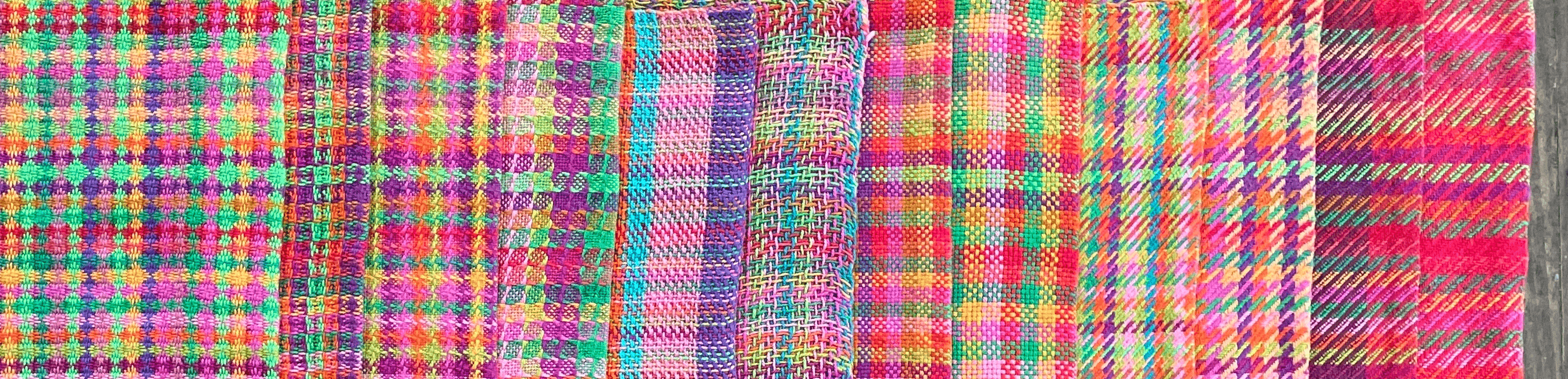
Banner picture: Pairs of samples woven at loose (~60% of calc. sett) and tight (~75% of calc. sett) of various structures on the same warp. I wove these samples for an article about drape and structure for the Spring 2026 issue of WEFT.
Comments