How the Color Nuggets towels came to be
Or, What makes a pattern a pattern. Hint: it’s not just the draft.
Lisa and I spend some of our time and energy writing weaving patterns. Some of our patterns are published in weaving magazines such as Handwoven and WEFT. Others are for sale on Lisa's Etsy shop (see here for a gallery). In each pattern, we provide the information necessary for weavers to make the items (towels, scarves, baby blankets, etc.): yarn, sett, draft, colors, etc. We also give instructions on how to weave the pieces and modify the pattern to suit each weaver's constraints and tastes.
How much of a pattern is common knowledge? How much is new? How much of the pattern comes from the combination of elements? It depends on the pattern, of course. In this post I'll look at how the Color Nuggets Towels pattern came to be, trying to parse out the various elements that make this pattern.
A few days ago, a fellow guild member drew my attention to a Facebook post pointing out that the structure of the Color Nuggets towels (recently published in Handwoven Magazine Summer 2026 issue) is the draft #47 in A Weaver’s Book of Eight Shaft Patterns (1991, Carol Strickler ed). Actually, Strickler indicates that the source of the structure is A Handbook of Weaves (1915, G.H. Oelsner, and that draft can be found in Handweaving.net as draft #34382). All of this was news to me, as I found the draft in Fabrics That Go Bump (2002, Madelyn van der Hoogt ed.), as one of three tie-ups used in a towel collection (Waffle family dishtowels, p. 46). In that project, the towels are woven on a warp with wide stripes, forming a plaid with the weft. While Strickler #47 is undoubtedly the structure of Color Nuggets, there is obviously more to Color Nuggets than just its structure. How much more, exactly?
For starters, in both Oelsner and Strickler, the structure is woven with a single color in warp and weft, while Color Nuggets is squarely in the color-and-weave camp. Color-and-weave motifs are formed by the combination of structure and threads of the right color at the right place in the structure. Right color at the right place in the structure is what I call "color placement" in the context of color-and-weave patterning. A straight 2/2 twill becomes houndstooth when woven on a warp with regular 4-end stripes with 4-picks stripes in the weft. It's magic! In the case of houndstooth, where the stripes fall on the threading (and on the treadling) doesn't matter. As long as you have 4-thread stripes in warp and weft with enough contrast between neighboring stripes, you'll get houndstooth. Try shifting the placement of stripes in your favorite weaving software!
The Color Nuggets structure, aka Strickler #47, is woven on a straight 8 threading, so the most obvious striping pattern is 8-thread stripes in warp and weft. Does the placement of the stripes matter to get a color-and-weave motif? Check out three possibilities below.

Figure 1. Three repeats in threading and treadling for each of the 9 draw downs shown here. We know all 9 have the same structure because we can see the same threading and treadling for all 9. It would be far less obvious without that information, as the draw downs look quite different. Color Nuggets is at the top right, and see below for a sample woven as the bottom left draw down. I haven't woven the top left draw down, which is a rotated version of the motif at bottom right. The other five draw downs look messy.
One can make an educated guess as to how threads will move to make the motif in each draw down more (or less) legible and interesting, but one has to weave the samples and finish them to be actually sure.

Figure 2. The bottom left draw down shown in Figure 1 looks quite promising, but it is not as pretty in the cloth, as shown here.
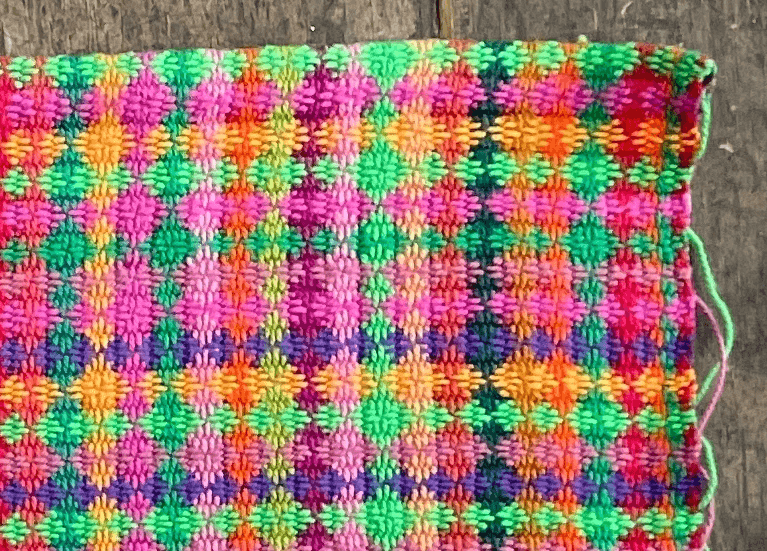
Figure 3. Color Nuggets sample (top right draw down from Figure 1) woven on the same warp as the sample above. This one looks better in the cloth than on the draw down….
As an aside, in case you are wondering… I didn't rethread the warp between the two samples with different color placements. Looking at Figure 1, note that you can read the tie-up in the top right draw down, where the warp color contrasts with the weft colors. To weave the other draw downs on the same threading as Nuggets, that is, with the 8 thread stripes matching the straight draw in threading and treadling, you only have to change the tie-up—much easier than rethreading the warp! Pick the draw down of your choice and read the corresponding tie-up in where warp and weft contrasts with each other. Voilà!

Figure 4. In case you needed proof… Here are the top left, top right, bottom right, and bottom left draw downs from Figure 1 all woven on the same warp and weft, but each with a different tie-up.

Figure 5. The same draft as Figure 4 showing only the structure and not the thread colors.
After this lengthy detour in the magical world of color-and-weave, let's return to Color Nuggets as a pattern.
We now have a structure and a color-and-weave motif. Let's weave something with these, like hand towels. My go-to yarn is 8/2 cotton and cottolin. The yarn choice determines the color space in which the rest of the design work will take place. I've written at length about how I choose colors in the article accompanying the Color Nuggets pattern in Handwoven. Suffice it to say that you need some contrast between neighboring stripes, generally speaking. What is a good sett for this structure, in 8/2 cotton? Possibly 24 epi, the sett I start with for 8/2 when I'm not weaving plain weave. Luckily, 24 epi is a good sett for Nuggets, so nothing particularly original here. The size of the towels is a matter of taste. I like my towels ample and rectangular, so I design them accordingly. We now have all the basic elements of the pattern.
I added a few technical suggestions, such as starting alternating colors of opposite sides and carrying the inactive yarn up the selvedge, and winding what I call a mixed warp to make winding stripes easier, and finishing instructions. Lastly, I offered some ideas on how to modify the pattern to suit a weaver's taste. I think of these as embellishments.
In other patterns, the bulk of the design revolves around color. I've designed a couple of projects in turned twill (Ellie's Napkins, available on Etsy, and Chameleon Towels, published in Summer 2026 issue of WEFT, page 48). The structure is blocks of 1/3 and 3/1 twill
Véronique
Banner picture: Color Nuggets, detail
Comments