Color and Structure
Lisa and I had planned to write alternate blog posts. Since I wrote last month’s post, Lisa was to write the November post. Well, sometimes life gets in the way, and I’m on duty for this month. You’ll have to wait for next month to hear from Lisa.
I often design warps with the goal of playing with colors. The design of the warp (threading, color organization (e.g., stripes, gradients, mixtures), structure, etc.) determines how the colors will interact. There are a few basic designs I return to, as I keep on finding new interpretations for them.
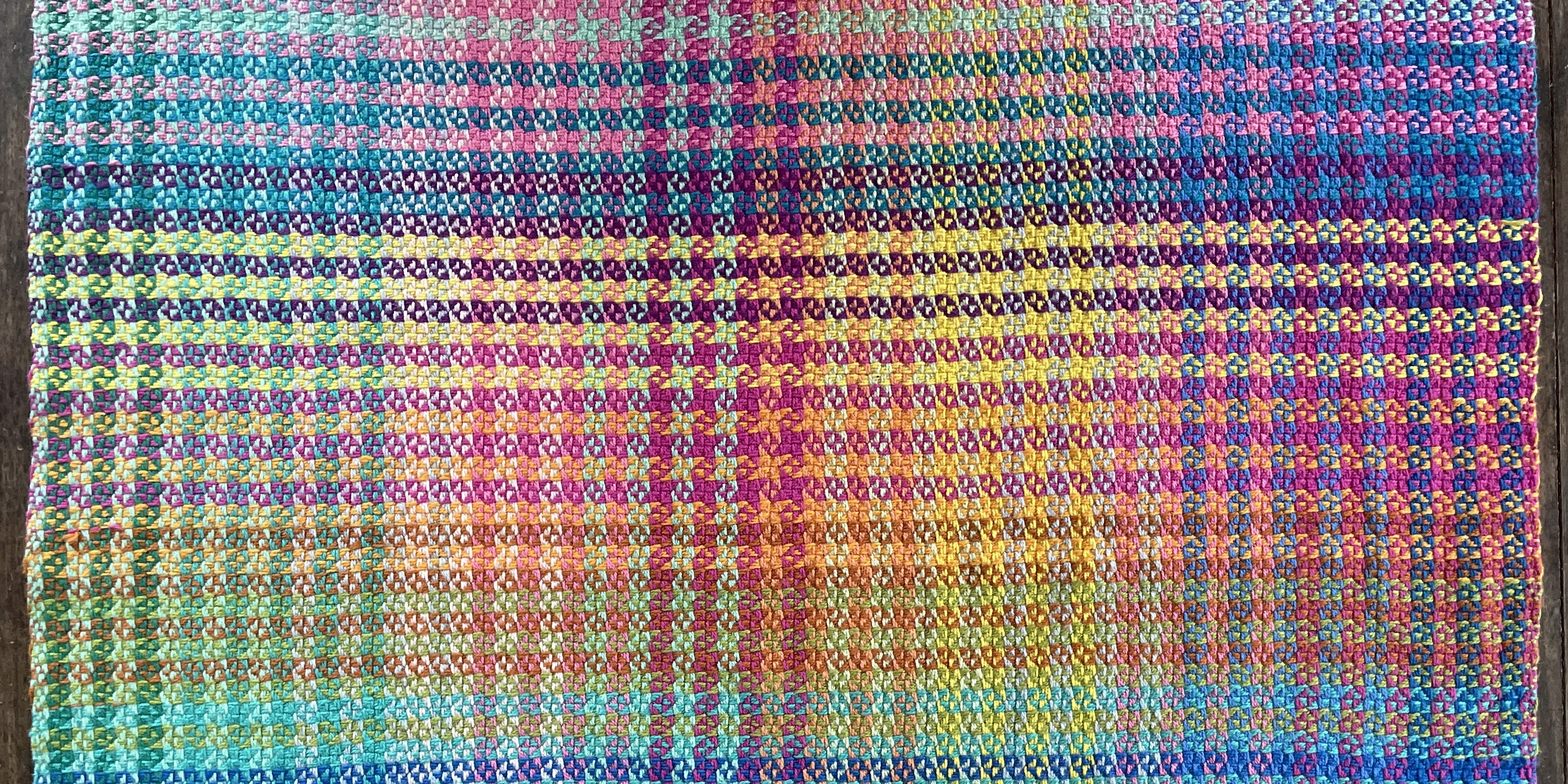
One such design is a warp of 8-end stripes of various colors, threaded with a straight draw on 8 shafts. The tie-up determines the structure, and many structures are possible on such a threading. With enough contrast between adjacent stripes in warp and weft, some of these structures produce color-and-weave motifs such as pinwheels or houndstooth. I like to use many colors (12 colors in the warp of the towel shown in the banner picture), and many color combinations, not only those with a lot of contrast between neighbors. As a result, the motif is not always legible: it comes in and out of focus. Each piece becomes a grand game of Where’s Waldo! Can you spot the pinwheels?
I just finished weaving such a warp. The first 4 towels were samples for a project for Handwoven Magazine—its Summer 2026 issue will be about color! I used the rest of the warp to weave the same weft colors with four different structures. As expected, structure influences how colors in warp and weft interact, especially in the areas where the motif is not legible.
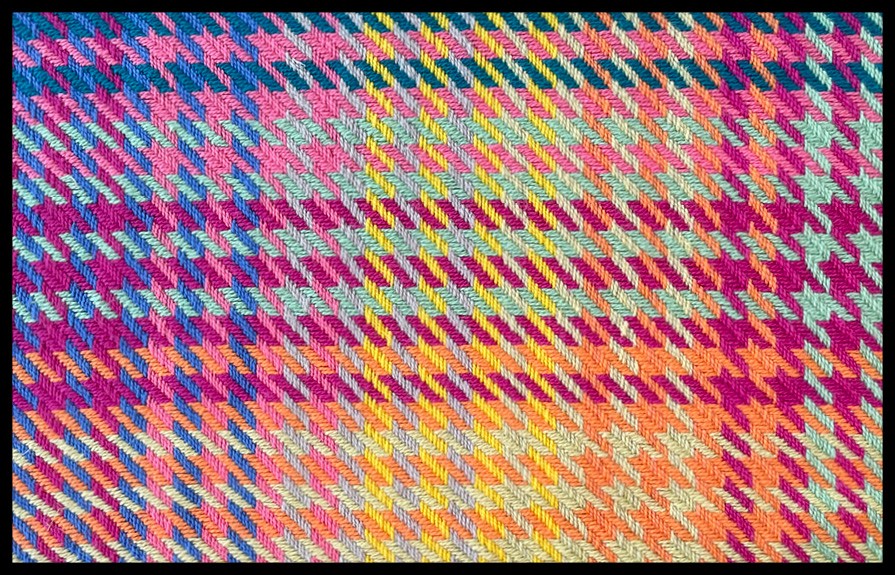
The strong diagonals of the straight 4/4 twill appear as hatchings that sometimes coalesce in the houndstooth motif.
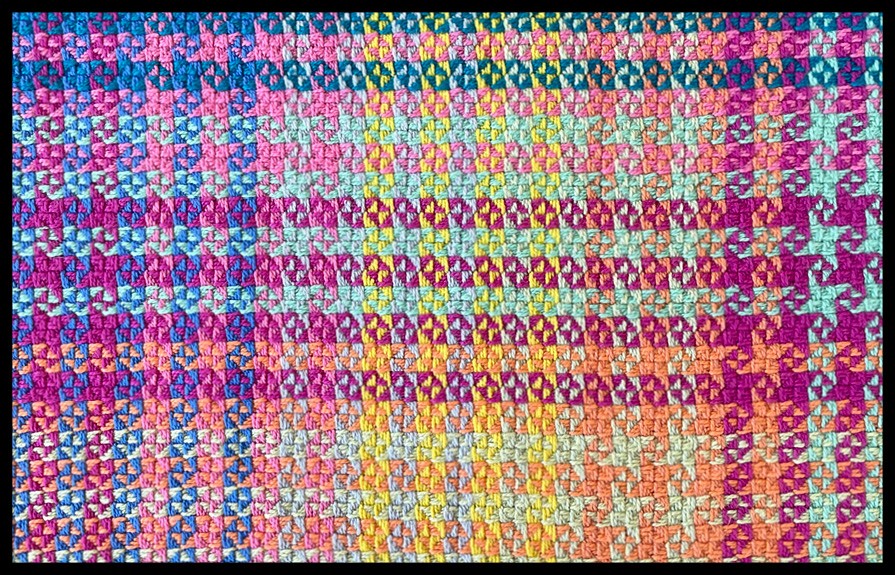
The Triangular Pinwheel gives a pointillism effect to the color mixing, with the triangular dots sometimes forming pinwheels.
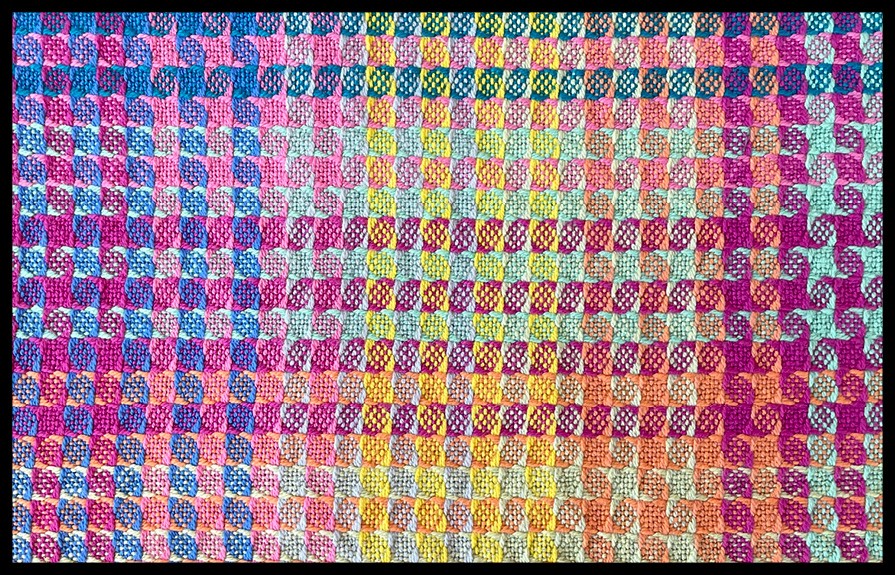
Because of the areas of plain weave embedded in the Classic Pinwheel, the colors meld with each other, and the pinwheel motif pops out here and there.
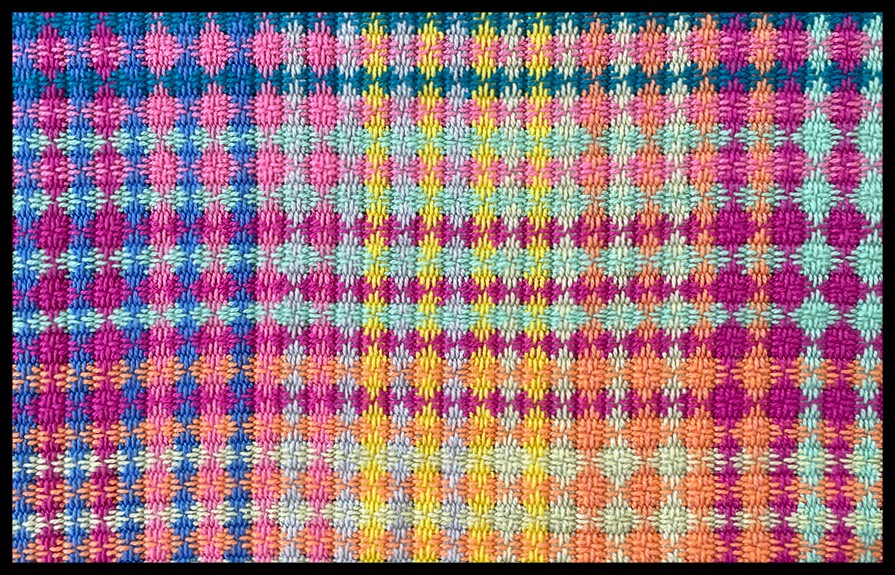
The float pattern of the Ribbed Squares shows up as small diamonds that occasionally fuse into large nuggets of color (thus the name I give to this structure—Nuggets).
Weaving these four structures in quick succession was an interesting experience. I had to recalibrate my beat after changing the tie-up to maintain the same spacing of the weft threads (at roughly 24 picks per inch) even though the structures felt different on the loom.
It was easy to beat the 4/4 twill too hard, as the 4/4 interlacement offers less resistance to the beater than the other three structures. The Triangular Pinwheels (click here for the tie-up and a good look at the structure) needed a little harder beat. Even though all the picks don’t follow the same path, the difference between them was hardly noticeable—they offer similar resistance to the beater.
With Nuggets, most picks needed a soft beat, while one pick required a rather firm beat. Specifically, the second pick of plain weave in the repeat needed to be pushed in place quite hard (check the structure below left). Classic Pinwheels required a surprisingly hard beat, so much so that it took me a few repeats to beat hard enough to square the beat! I should have seen it coming: Classic Pinwheels have large dots of plain weave at the center of the motif, and 24 epi is a tight sett for plain weave in 8/2.
Now for the surprise: Nuggets and Classic Pinwheels are composed of the same picks, in the same order! You can check them out below.
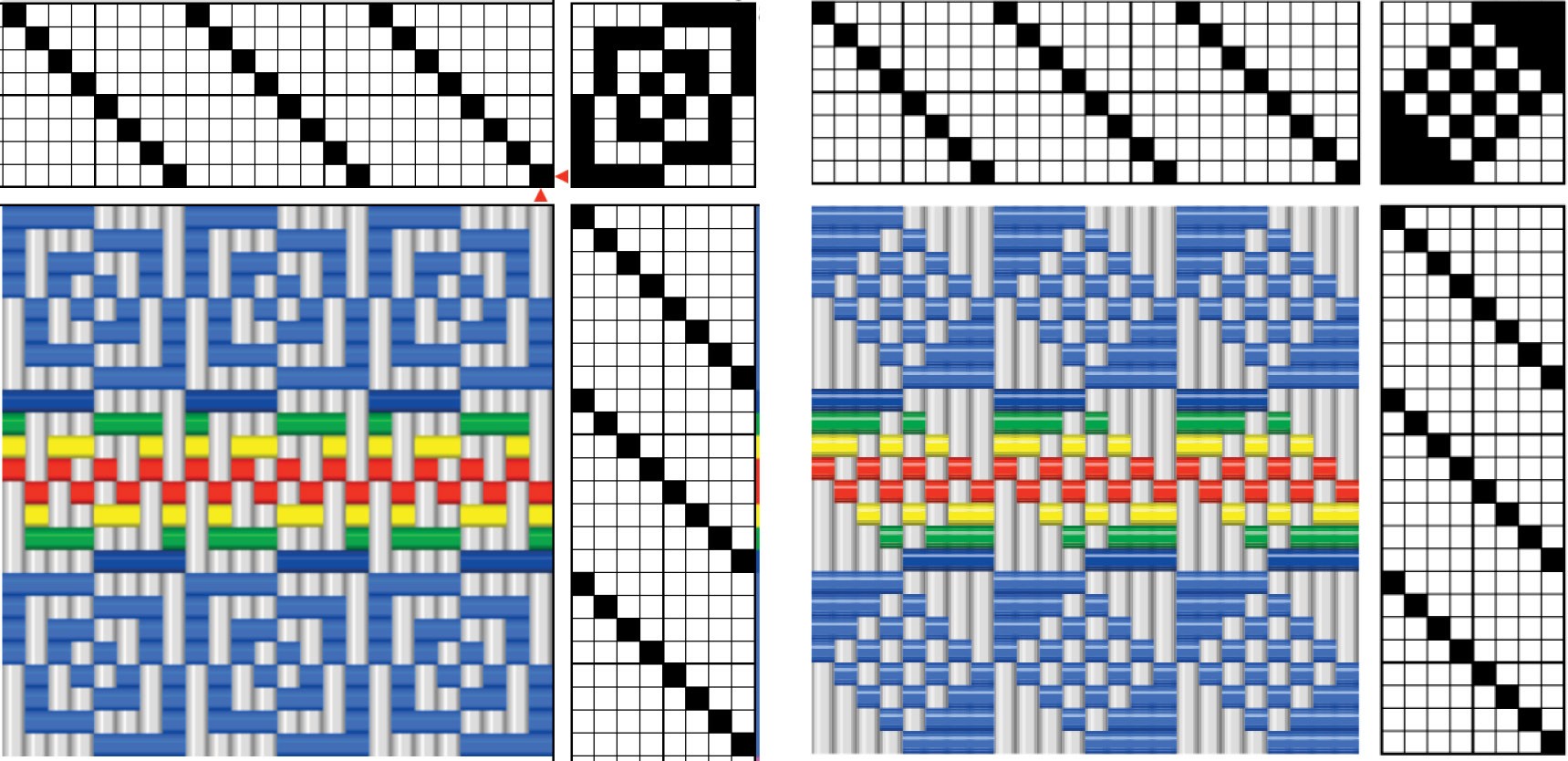
Tie-up and draw-down for Nuggets (left) and Classic Pinwheels (right). One treadling repeat is color coded, with each pick with a different path shown in a different color. The 4/4/ picks are in dark blue, 3/1/1/3/ picks are in green, 2/1/1/1/1/2/ in yellow, and 1/1/ (plain weave) in red. For more about pick representation, click here.
Since Classic Pinwheels and Nuggets are made of the same picks, they both have the same calculated sett (53 dpi (for 8/2) x 0.635 = 33.7 epi). Innocently, I expected that weaving them at the same percentage of their calculated sett (100 x (24 epi / 33.7 epi) = 71%), I would have to put the same force on the beater to beat square. Such was not the case! Here is an excellent example that, however tempting it is to trust the theory blindly and put one’s brain on brain saver, reality is what counts. Pay attention to what’s happening on the loom!
The difference between the two structures lies with the alignment of the picks within the repeat. In Nuggets, the picks are aligned so that there is very little plain weave interlacement (over one, under one) despite two picks of plain weave, while about half of the Pinwheel repeat area is in plain weave. This is an extreme case of same picks/different alignment. You are probably familiar with other examples of the same phenomenon, such as 2/2 twill and basket weave. Both 2/2 twill and basket weave have an over 2, under 2 interlacement in warp and weft, and a complete repeat is 4 ends by 4 picks. For basket weave, a repeat is made of 2 identical picks (or ends), then 2 identical picks (or ends) offset by 2. For 2/2 twill, each of the 4 consecutive pick (or end) is offset by 1. How different does each member of the pair feel when woven?
Put another way, a woven structure is not entirely described by the path of each pick and end, despite what the theory behind calculated setts would have you believe! Plain weave is the one exception to this observation: it is exactly over 1, under 1 in warp and weft.
Véronique
Banner picture: Towel woven in 8/2 cotton and cottolin; warp and weft are in 8-thread stripes of various colors; structure is triangular pinwheels.
Comments