Choices, choices...
Designing or creating anything can be reduced to whittling down whole universes of possibilities into to a single collection of choices. At the beginning of the design process, everything is (more or less) possible. Before I start designing it, my next weaving project could be a baby blanket / a set of towels / yardage for clothing / pillow covers / a light scarf / etc., in whatever yarn or yarn combination I can imagine, in the structure of my choosing, in the colors and size of my choice…
From the beginning, the final project is circumscribed by what I can think of. If the only yarn I have at hand is natural cotton, I’m unlikely to plan to weave a rainbow woolen blanket. It is easy for me to get comfortable in my corner of the weaving universe, especially when I get really good at weaving whatever populates that corner. Occasionally boredom pushes me to venture out, or some external force plants a new idea in my mind. Serendipity plays a large role in the latter: it could be a guild project, the gift of a bag of yarn, a textile seen in a shop window, a class taken on a whim… the list is long. If I take up the challenge, I run the risk of running down blind alleys—or what looks like one.
A blind alley is any project that doesn't pan out, at least in this particular incarnation. The draft looked good on paper, but the floats ended up moving too much / not enough / in the wrong way, and the resulting cloth is blah; or the yarn looked really good on the cone, but it turned out to be too stiff / too soft after finishing, and I don't like the hand of the cloth. There is always something to be learned from failures: they offer information about new-to-me corners of the weaving universe, sometimes worth exploring further, and sometimes not. Nothing ventured, nothing gained.
Then the pruning—ahem, the designing—begins. Each choice narrows down the options for subsequent choices. If I want to weave a set of kitchen towels, animal fiber yarns are not in the running anymore. If I want to weave with some heavy wool yarn, I’m likely to weave a blanket or heavy dress fabric. If I want to weave a deflected double weave project, I need to come up with a pair of yarns where I can have some contrast between the two yarns (in color, texture, thickness, or shrinkability) for the patterning to appear. If I want to weave a rendition of spring in Georgia, I need yarn with a large number of greens.
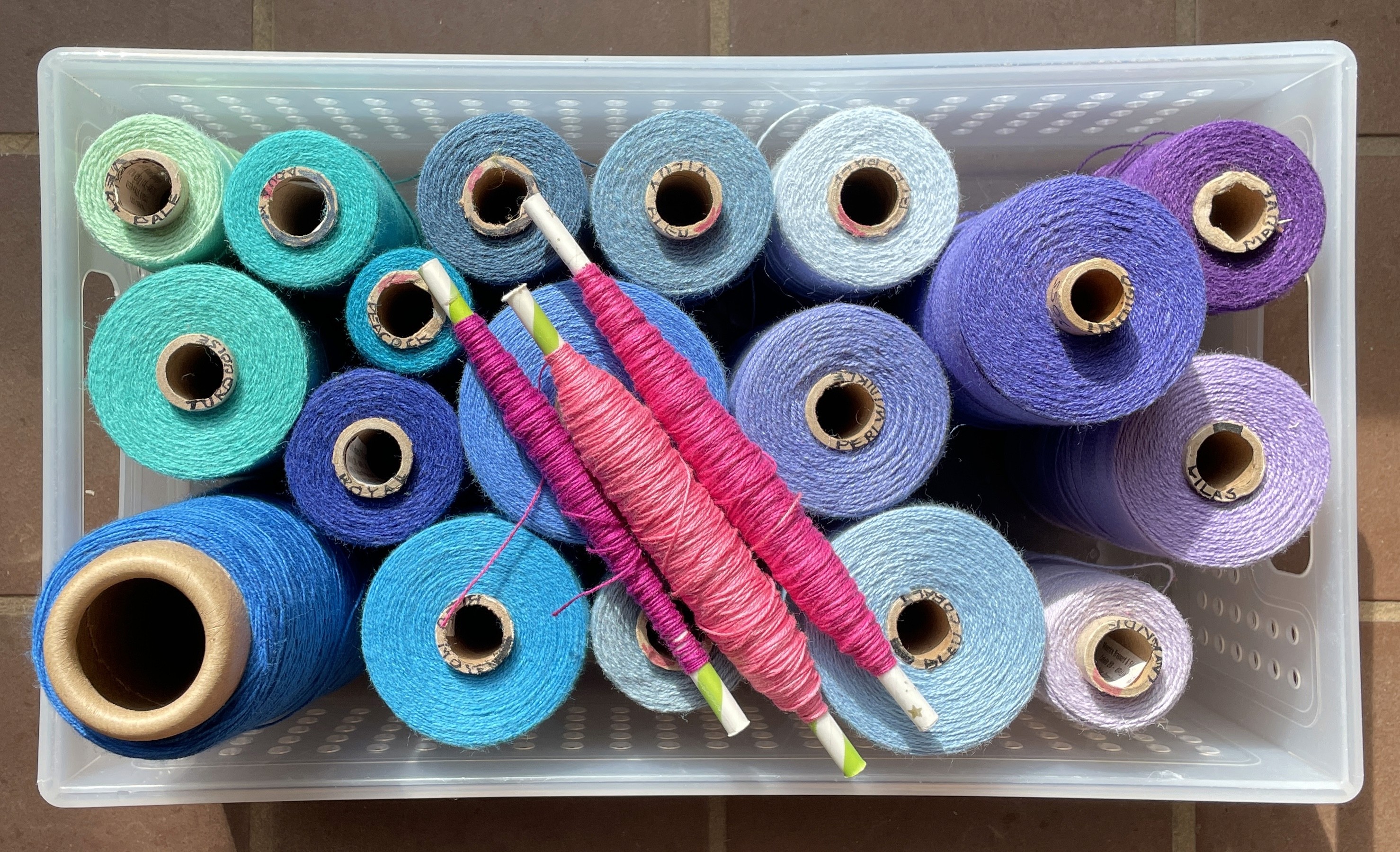
Choice after choice, at some point I have the gist of the project. For example, let’s say that I’ll weave a set of towels, in 8/2 cotton and cottolin, around 20 inches wide, in turned twill (1/3 and 3/1 twill, so on 8 shafts). The structure and the yarn determine the sett: 24 ends per inch, so we are looking at about 24 x 20 = 480 ends, or 480 / 4 = 120 threading units (see below). For the colors, I’d like blue towels, so I collected all the 8/2 I have in blue and nearby colors.
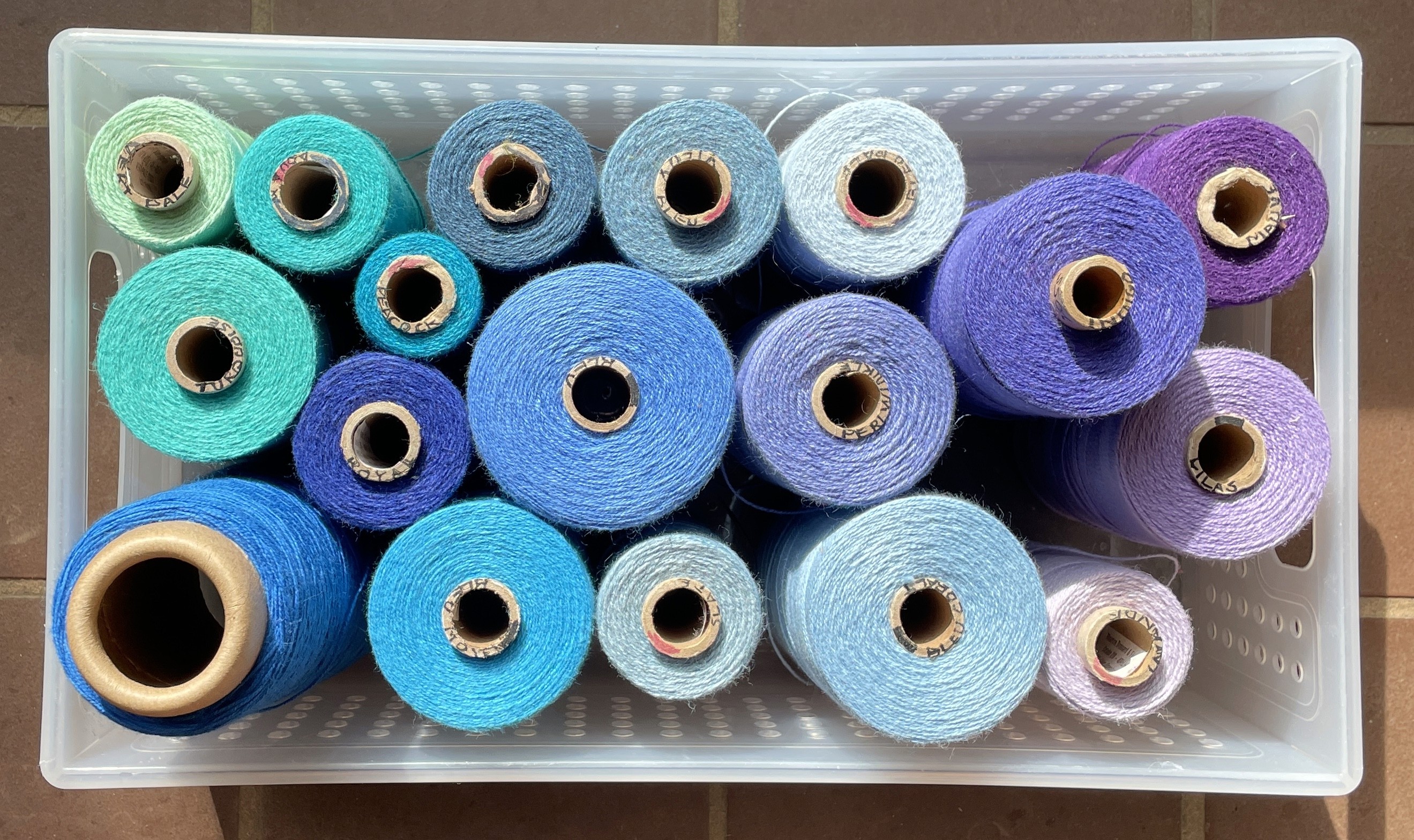
Blues: 18 colors, mostly Brassard, with a cone from Lofty Fiber and a tube from Bockens
In many ways, these first choices were the easy ones. Now we get to the nitty-gritty stuff. There will be stripes, both in the structure (in the turned twill blocks) and in the warp colors (I like to weave turned twill on a striped warp): how wide the stripes? All the same or different widths? Will color changes match block changes? The cloud of blues will have to become a line of blues, with possible additional colors.
For the stripes, the easy choice is one single stripe width across the warp, the same width for color and threading blocks, and color changes match block changes. In this situation, I only have to choose one number, the stripe width. And because the threading unit is 4 threads, life will be a lot easier if the stripe width is multiple of 4. With these decisions, the warp will be color-coded (threading block changes when warp changes color), and there will be an exact and constant number of threading units per block (if I wound the warp colors accurately, of course).
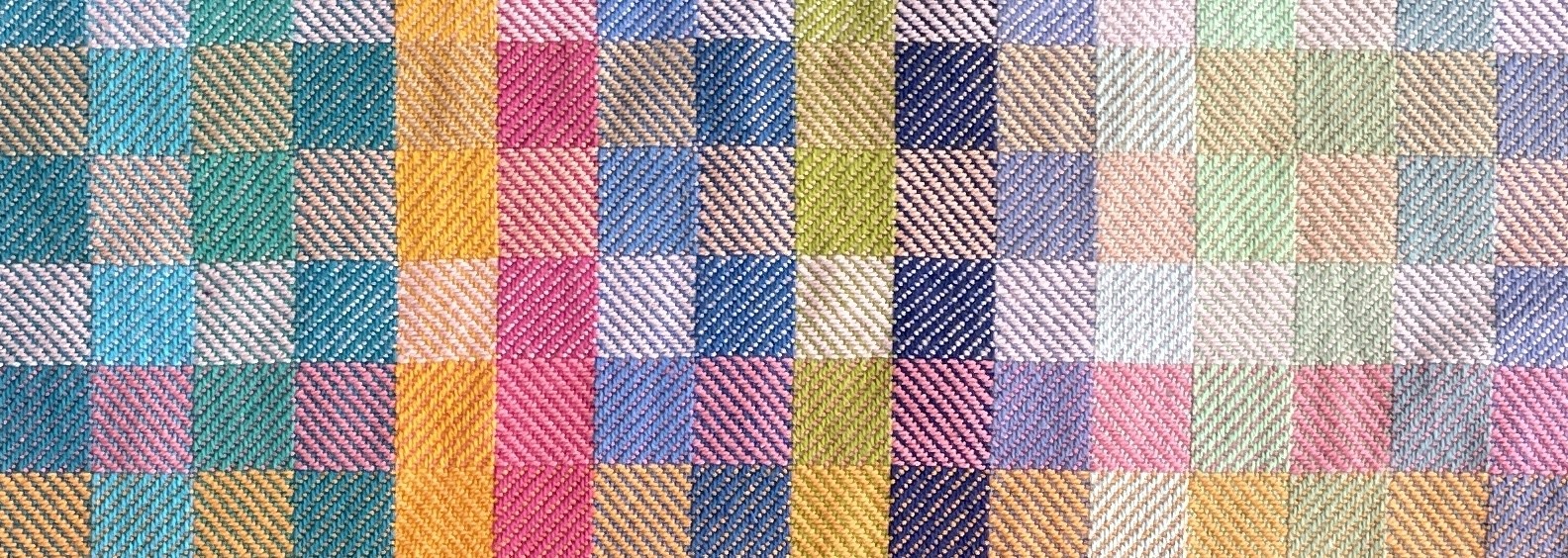
Single width stripes, with block changing at the same time as color, in warp end weft.
Identical stripes are not the only possibility. If I go for non-identical stripe widths, I have to make more decisions: one width for each stripe. The technical constraint of the stripe width a multiple of 4 remains, both for the block width and the color stripe width (I usually wind warps 2 in hands, so one full circuit of the warping board yields 4 ends).
For truly random stripe width, one option is to roll a die to determine the number of threading units, for each stripe. Another option is to find a way to generate a sequence of numbers following some rule (e.g., the Fibonacci sequence; the Fibonacci sequence is an interesting mathematical object, but I don’t find stripes in Fibonacci width especially harmonious). Regardless of the source of the sequence of stripe widths, it behooves the designer to look at the overall effect and tweak as needed.
Either process can be used for one set of stripe widths and applied to both threading blocks and color stripes (benefit: the warp is still color coded; irregular color stripes will take attention when winding the warp). It can also be done separately for threading blocks and color stripes. The threading will be more challenging, as the number of units in each threading block will have to be read from the draft.
A less extreme solution is to decide on a few widths, something like wide, medium and narrow, decide on how many of each and their placement, and use them in conjunction with the colors. The narrow stripes make it possible to add small stripes of contrasting colors.
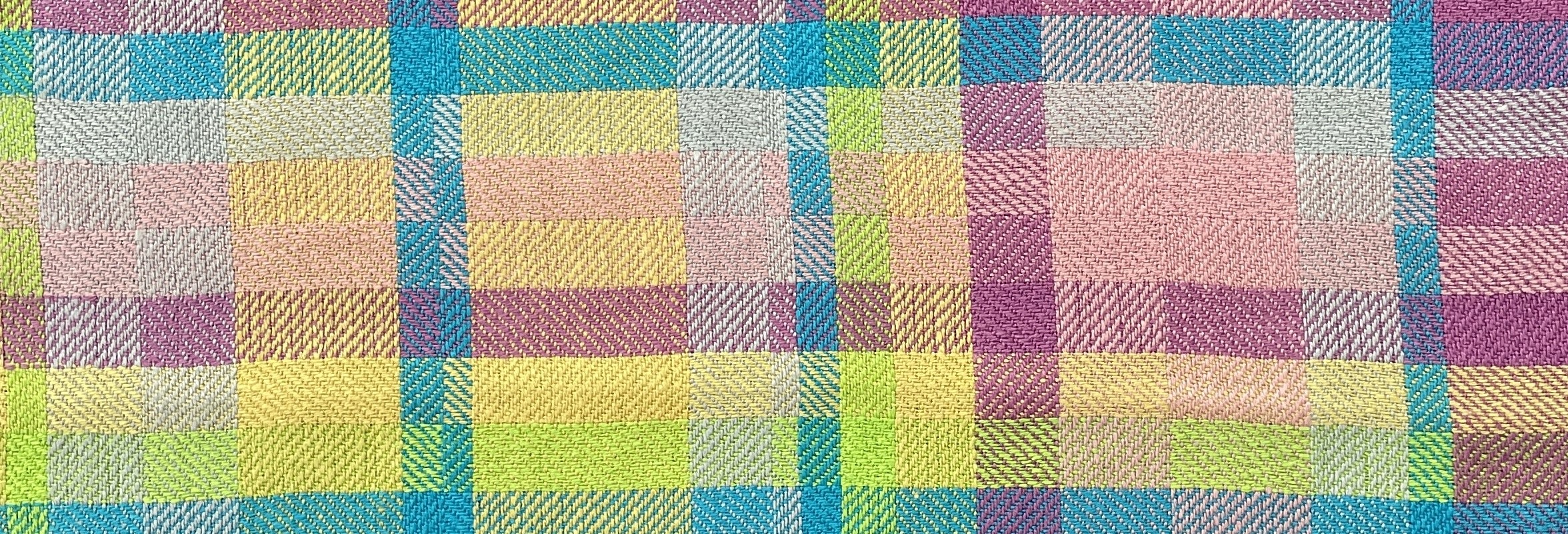
A handful of possible sizes for warp stripes, singe width for weft stripes (Ellie’s Napkins, Morgan's colorway)
For this warp, I decided to use a single threading block width, fairly wide; let’s set it at 1.5 inches, or 9 threading units per block. I like wide towels, so let’s have 15 blocks, or a total of 15 x 9 x 4 = 540 ends, or 22.5 inches in reed. For the color stripes, I decided to have block changes not coincide with color changes, and to have the color stripe widths pleasingly (!) random. I used an 8-sided die to generate a sequence of numbers between 1 and 8, nudging it here and there to force color changes away from block changes. With the help of a spreadsheet, I have a list of 28 stripes between 4 and 32 ends to which I have to assign a color.
There is a nice range of values in the 18 blues and allied I found on my shelves, but it will probably need other colors to enliven the warp. The recommendation from traditional color theory would be to add some complementary colors to blue, which would be orange, but I like pink better. I’ll likely put the contrasting pinks in the narrow stripes. It will take a while to come up with a complete list of colors for this warp, longer than I have time for before publishing this post.
So far, we were designing the warp. Some warps are one-trick ponies: they can be woven in only one or a small number of ways, which means that most of the choices regarding how these warps will be woven are already made. Other warps offer many options; a turned twill towel warp is one of the latter. The yarn and the sett are set (8/2 at 24 picks per inch), but the same decisions about stripes and colors have to be made: what colors, in what order, for how long, in what treadling block(s)… If you want to see how one such warp turned out, have a look at the Chameleon Towels in the latest issue of WEFT (Summer 2026).
Sometimes I delegate some of these decisions to my leftover bobbins. I call it the “empty the bobbins” game. Since I use so many colors, I need a vast number of bobbins. For price, space and flexibility reasons, I use paper straws as bobbins, so I can easily make more bobbins. With each project focused on colorplay, I accumulate bobbin ends with a few yards of yarn, and I occasionally want to reclaim bobbins. The general idea is to collect all candidate bobbins and come up with rules on how to weave with them. I usually sort them out to get color transitions I like, but you could sort them in piles (blues/reds/greens/ etc, or bright/pastels/neutrals, or little yarn/little more yarn/much more yarn/, or…) and randomly pick a bobbin from each pile. I add the rule that a bobbin has to be used up—we’re trying to empty the bobbins after all! Now for the treadling. You could keep regular treadling blocks (of the width of your choosing). I usually decide to change treadling blocks only within a bobbin (i.e., never when a bobbin ends). Not all the bobbin ends I lined up end up being woven this time, but I usually get back a nice pile of bobbins
Nitty-gritty choices are also both time- and energy consuming. On the plus side, designing-as-you-weave keeps the weaving of a long warp entertaining (each piece can become its own adventure), but it also slows down the weaving (it is a lot faster to weave one’s way through a known sequence of colors than having to decide on each color. It is also faster to have fewer color changes…).
Because of the fatigue that comes from incessant choices, it is tempting to delegate, to have the choosing done by anything but me. Once again, there is nothing wrong with delegating, as long as one doesn’t abdicate. In the end, as the designer I retain control over and responsibility for the design. I can’t hide behind the Fibonacci sequence and say “it’s not my fault if these stripes don’t look good, it’s Fibonacci’s.” If the stripes given to be by my die rolls don’t please me, it’s up to me to tweak them until they do.
I had a recent experience of how exhausting it can be to have to make choices all the time. This past spring I took a wedge weave tapestry class with Connie Lippert at the John C. Campbell class. Check out Connie’s work; it’s beautiful! (connielippertart.com). In wedge weave, the weaving starts with a small wedge on one side of the warp. Each pick is added to the wedge, forcing the weft away from being at right angle with the warp. This technical constraint offers a canvas on which I can play with colors without having to decide on what to draw: my kind of jam! Weaving tapestry is slow work, even when using a floor loom to make the sheds. I noticed that I could weave until dinner, but I was too tired to put in a couple more hours after dinner. And it wasn’t the physical effort (if anything, regular floor loom weaning uses more muscle power); it was having to decide every few picks what color would come next.
I hope I have given you a taste of what a double-edged sword choice is. Choice is the super power of the designer, and it is also the bane of the designer, especially when it comes to the nitty-gritty of a project. I often come up with design rules to narrow down the choices (e.g., rules for the “empty the bobbins” game). One danger is to forget that these rules are self-imposed constraints to help the design process, not hard and fast, “true” rules.
Happy weaving!
Véronique
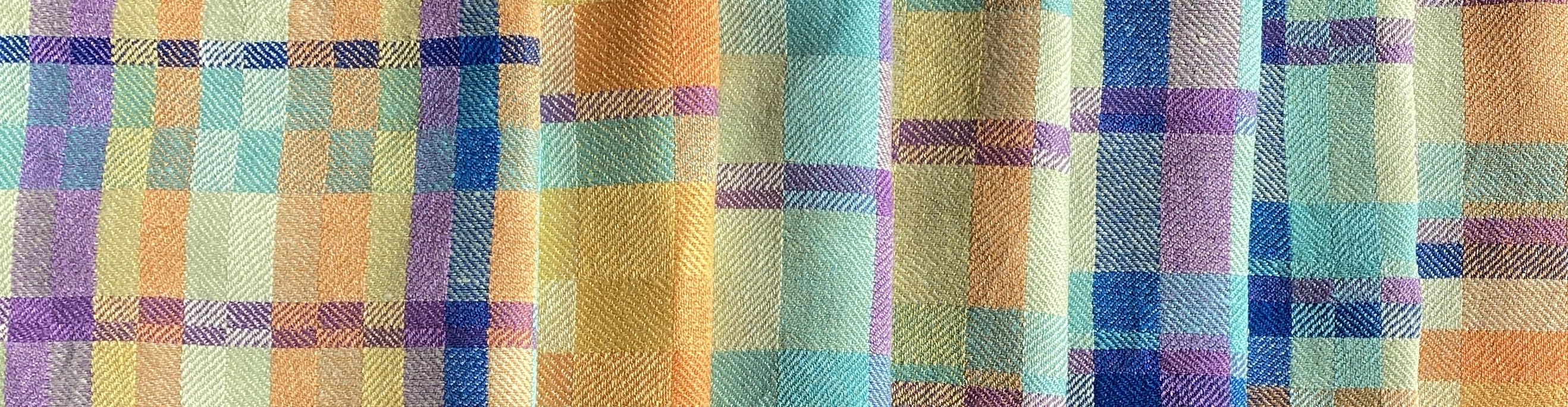
Banner picture: Multiple treadling options on a single warp (Ellie's Napkins)
Comments